
Approved baseline
- Milestone
- First playable co-op mission
- Goal
- Prove the two-player mission loop.
- Definition of done
- Two players can join, complete the ten-minute mission, and finish the boss encounter at the agreed performance target.
Milestone baselines and change tracking for game-production leaders
Every change made sense at the time. Twelve of them later, nobody can say how the plan got here. DriftWarden holds the baseline everyone agreed to and tracks what moved against it, so you can see what's really left and fix it while there's still time.
No confidential document required - we will use a sample milestone.
Founding-studio rate: $99/month - five spots - founder-led onboarding
Why the plan moves and no one can say how
Each request looked manageable on its own. Together, they changed what the team was expected to deliver.
From agreement to what happens next
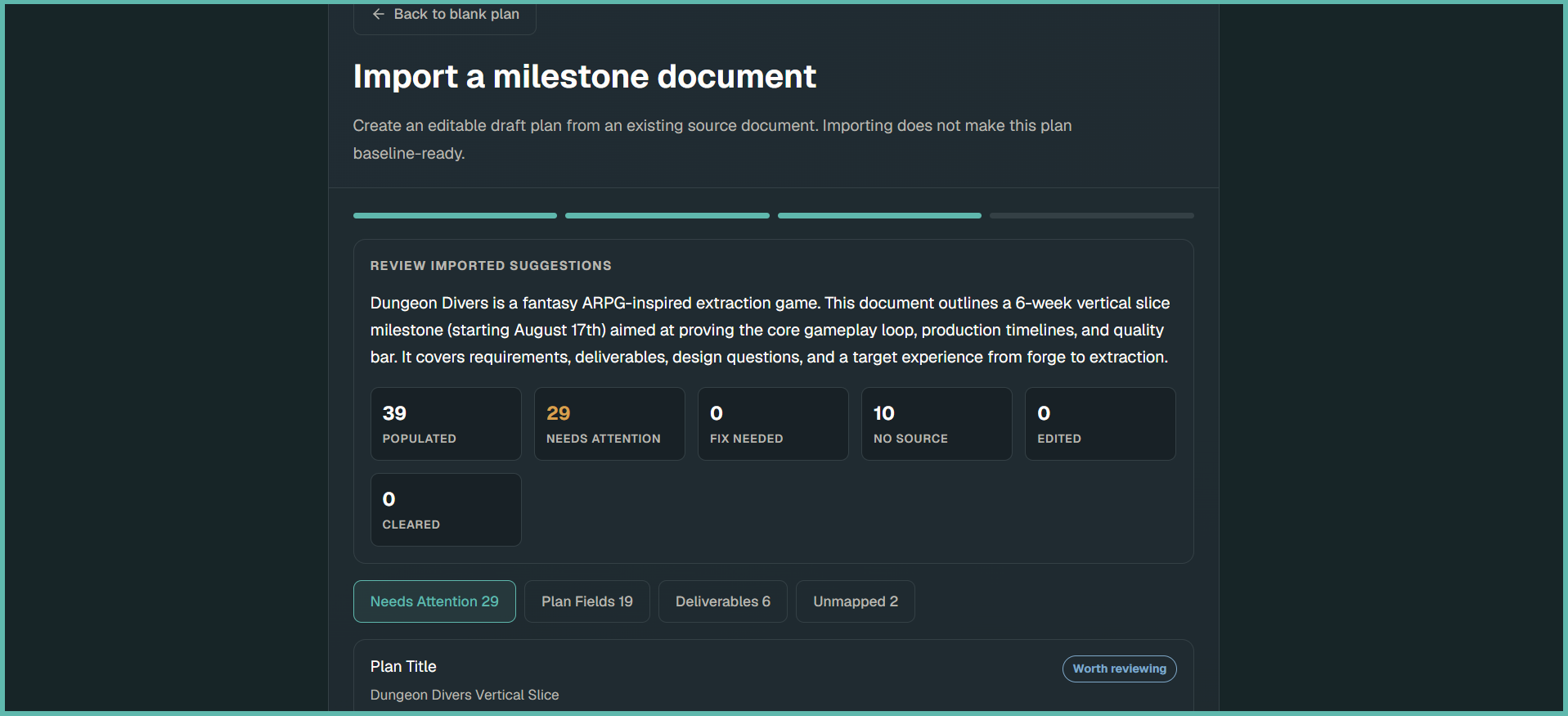
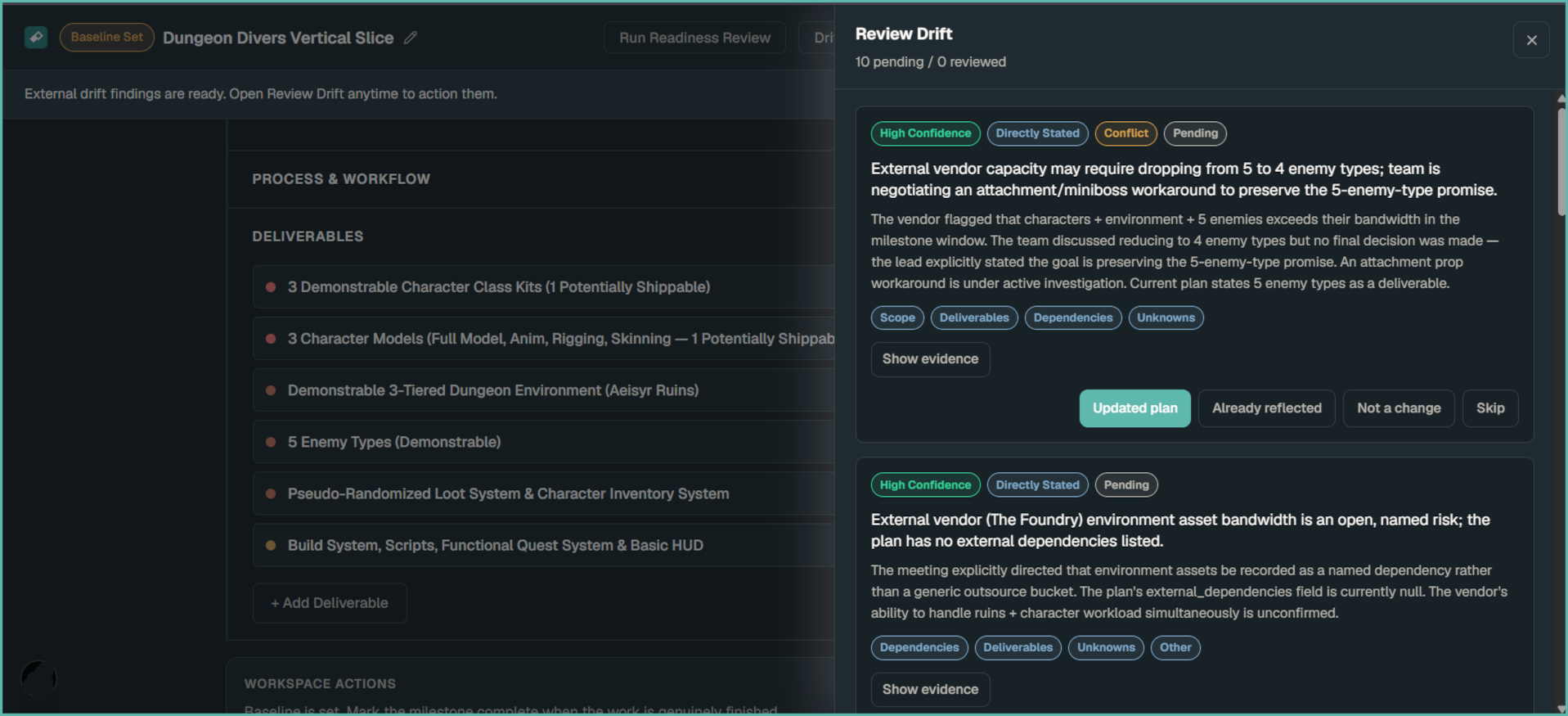
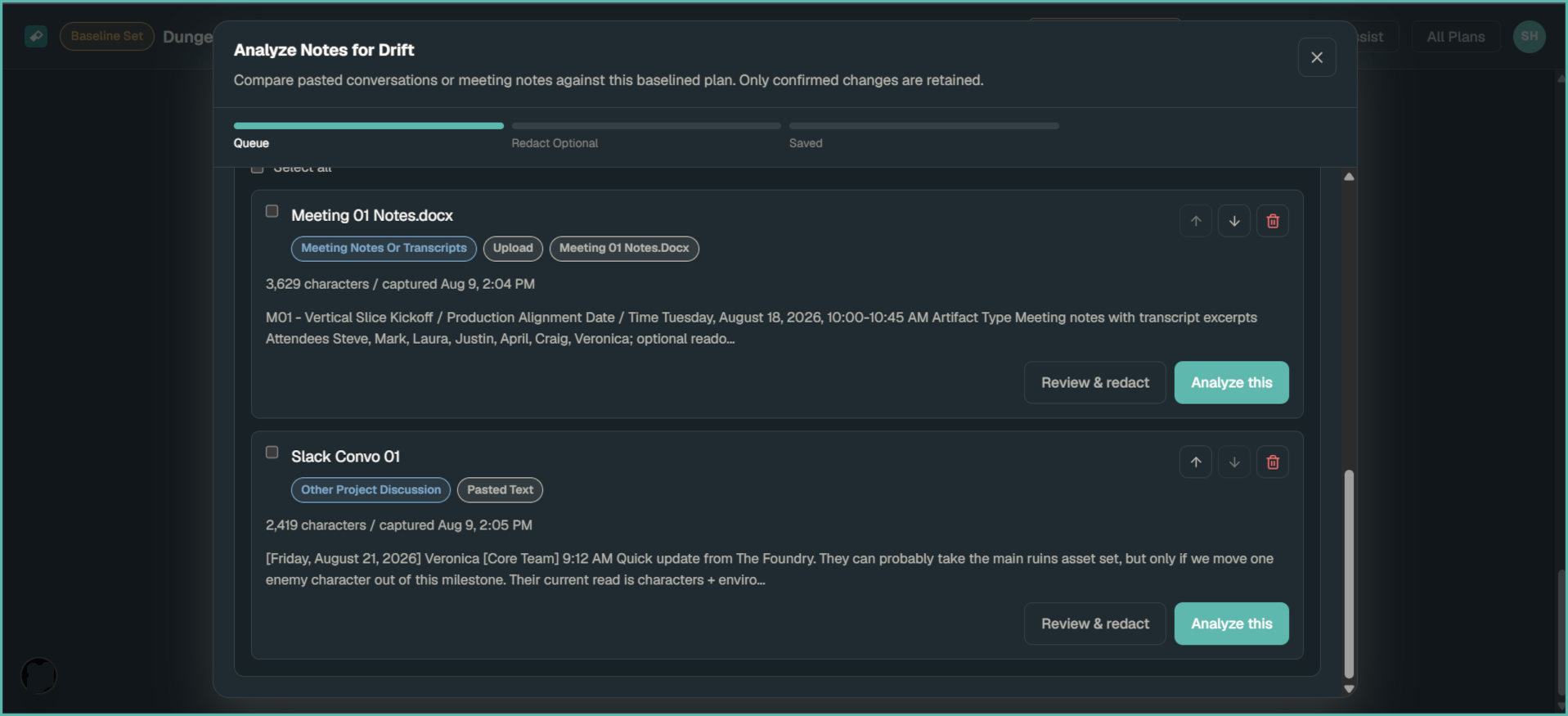
What you can answer
Bring the approved baseline, change history, and current readiness picture into the same conversation instead of reconstructing the milestone from scattered evidence. That helps at the review. It helps more in week nine, when you can still act on it.
Works with your current system
Jira and ShotGrid manage work. Planning documents describe the milestone. Chat and meeting notes capture decisions.
DriftWarden sits above those systems as the milestone record: what the team agreed to deliver, how that agreement changed, why the changes mattered, and what that means for the work that's left.
It is not another backlog, sprint-management system, or resource-planning tool.
AI and data handling
DriftWarden uses AI to help map imported plans, challenge ambiguity, surface possible risks, identify potential drift, and raise readiness questions.
Nothing becomes a confirmed plan update or drift entry without user review.Five early-access studios
Use DriftWarden on real milestone work with founder-led onboarding and first-project support—and help shape where the product goes next.
Five founding studios join at this rate. Pricing will be higher for studios who join after.
Request a walkthroughFounding Studio access includes:
The best fit is a production leader who owns or reviews real milestone commitments.
Co-development and work-for-hire studios use it to know which change is worth pushing back on, and to make the case for a scope or staffing change before it comes out of the margin.
Core teams and publisher-funded studios use the same baseline and change history to see whether the remaining plan still reaches a ship date.
Externally reviewed milestones are the initial focus; high-stakes internal milestones fit the same way.
A request starts a conversation. You will not be asked to upload a confidential document before we talk.
Founder
DriftWarden was created by Shawn Ketcherside, a production leader with more than 25 years across AAA, new IP, MMOs, co-development, and live/mobile games, including work with BioWare/EA, Bethesda Game Studios Austin, Playful Studios, PeopleFun, and Wildcard Alliance.
His shipped work includes Star Wars: The Old Republic, DOOM (2016) multiplayer, Super Lucky's Tale, and Wordscapes. He came up through engineering, into design, then into production, so he didn't arrive at this problem from the outside. DriftWarden grew from a pattern he hit again and again: teams could always show what the milestone looked like today, but not how it got there. Every replan started from memory and hope.
Connect with Shawn on LinkedInQuestions
No. DriftWarden complements the tools that manage tasks, schedules, documents, and communication.
It preserves the milestone baseline, records consequential changes, and supports readiness review.
The baseline is not an old plan the team must return to. It is the fixed reference used to understand how the plan evolved.
Plans should change. The baseline keeps that change visible.
No. The standard demo uses a realistic synthetic milestone, meeting notes, and chat excerpts.
Testing one of your own documents later is optional.
No. The record is useful that way, but that's a byproduct. The point is to know how the plan moved while you can still do something about it — re-scope, re-staff, or re-baseline before the date does it for you. Most of the value shows up in week nine, not at the review.
No — but externally reviewed milestones are the strongest initial use case. Co-dev and work-for-hire studios use the baseline and change history to decide when a change is worth pushing back on. Studios shipping their own titles use the same record to adjust roadmap and schedule and stay on track to ship — and to hold their co-dev partners to a shared, agreed baseline.
No. AI can identify ambiguity, suggest improvements, and surface possible drift. A user must review and confirm every change added to the milestone record.
Not yet. DriftWarden is entering a limited paid early-access period.
Early participants should expect the product to evolve and will have a direct opportunity to influence it.
Yes. The five founding studios join at $99/month and keep that rate for as long as they stay subscribed. Pricing will be higher for studios who join after the founding cohort.
Still time to steer
Go into the review already knowing what was agreed, what changed, and why, instead of scrambling to reconstruct it. Better yet, know it in week nine, when re-scoping is still a decision instead of an apology.
Five founding-studio spots - $99/month, locked for as long as you stay subscribed - founder-led onboarding